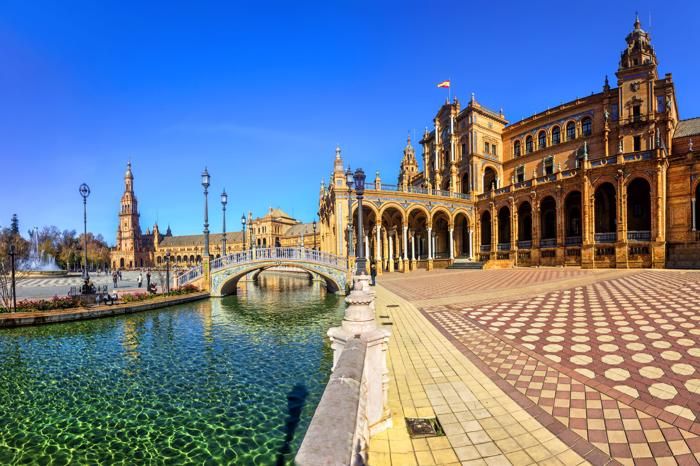
The elegant Plaza de Armas, beautifully laid out with palm trees, gardens and fountain, is faced on three sides by arcaded colonial buildings (rebuilt after an earthquake in 1863) with many restaurants, and on the fourth by the massive cathedral. The cathedral was founded in 1612 and largely rebuilt in the 19th century. It is remarkable for having its façade along the whole length of the church and takes up one full side of the plaza. Inside is a fine Belgian organ and elaborately carved wooden pulpit. Despite improved building techniques, the June 2001 earthquake famously caused one of the cathedral’s twin towers to collapse. Repairs were completed in 2003. The entrance to the cathedral is on the plaza. Behind is an alley, Pasaje Catedral, with handicraft shops and places for tourists to eat.
A visit to the church and cloister of La Compañía at General Morán y Alvarez Thomas, is recommended. The main façade (1698) and side portal (1654) are striking examples of the florid Andean mestizo style. There are two adjoining cloisters now given over to attractive shops. Also of note is the Capilla Real (Royal Chapel) to the left of the sanctuary, with mass daily at 1200, and its San Ignacio chapel with a beautiful polychrome cupola. The stark cloister is impressive.
The Universidad de San Agustín has an archaeological museum (Alvarez Thomas y Palacio Viejo) with an interesting collection of ceramics and mummies.
Also worth seeing, west of the plaza, are the recently restored church of San Agustín and La Casona Chávez de la Rosa, which holds art and photography exhibitions.
One of the major sites in Arequipa, Museo Santuarios Andinos (La Merced 110) contains the frozen mummies recently found on Ampato volcano. The mummy known as ‘Juanita’ is particularly fascinating.
Museo de Arte Textil (Patio del Ekeko, Mercaderes 141) has an interesting collection of textiles and shows short documentaries about Arequipa. The 16th-century church of San Francisco also has a convent and library and opposite is the interesting Museo Histórico Municipal (Plaza San Francisco 407) with much war memorabilia.
Arequipa is said to have the best-preserved colonial architecture in Peru, apart from Cuzco. Several fine seignorial houses with large carved tympanums over the entrances can be seen in the city centre. They are one-storey structures, and so have mostly withstood the earthquakes that regularly pound this city. They are distinguished by their small patios with no galleries, flat roofs and small windows, disguised by superimposed lintels or heavy grilles. Since many of these buildings are now banks and have heavy security it can sometimes be difficult to get inside for a good look around.
One of the best examples is the 18th-century Casa Tristán del Pozo, better known as the Gibbs-Ricketts house (San Francisco 108). Other good examples are the Casa del Moral, or Williams house (C Moral 318 y Bolívar) with a museum; Casa de la Moneda (Ugarte y Villalba) behind Santa Catalina convent; and Casa Goyeneche (La Merced 201 y Palacio Viejo). In the next block south is the early 17th-century church of La Merced (La Merced 303.)
The 17th-century church of Santo Domingo (Santo Domingo y Piérola) has a fine door, on which an indigenous face can be seen amid the flowers and grapes. The central San Camilo market (between Perú, San Camilo, Piérola and Alto de la Luna) is worth visiting, as is the Siglo XX market, to the east of the rail station....
Get the best info about sights, places to eat and sleep in Around the centre free to download!
download free pdf
