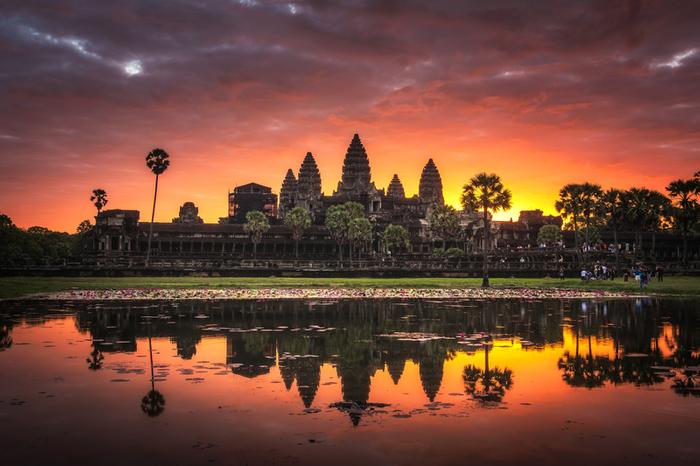
A lake (from Latin lacus) is a body of water or other liquid of considerable size contained on a body of land. The vast majority of lakes on Earth are fresh water, and most lie in the Northern Hemisphere at higher latitudes. In ecology the environment of a lake is referred to as lacustrine. Large lakes are occasionally referred to as "inland seas", and small seas are occasionally referred to as lakes. Smaller lakes tend to put the word "lake" after the name, as in Green Lake, while larger lakes often invert the word order, as in Lake Ontario, at least in North America. In some places, the word "lake" does not correctly appear in the name at all (e.g., Windermere in Cumbria).
Over 60% of the world's lakes are in Canada; this is because of the deranged drainage system that dominates the country. The license plate of the Canadian province of Manitoba used to claim "100,000 lakes" as one-upmanship on Minnesota, whose license plates boast of it being the Land of 10,000 Lakes.
Finland is known as The Land of the Thousand Lakes (actually there are 187,888 lakes in Finland, of which 60,000 are large), and the U.S. state of Minnesota is known as The Land of Ten Thousand Lakes.
Only one lake in the English Lake District is actually called a lake; other than Bassenthwaite Lake, the others are all "meres" or "waters". Only six bodies of water in Scotland are known as lakes (the others are lochs): the Lake of Menteith, the Lake of the Hirsel, Pressmennan Lake, Cally Lake near Gatehouse of Fleet, the saltwater Manxman's Lake at Kirkcudbright Bay, and The Lake at Fochabers. Of these only the Lake of Menteith and Cally Lake are natural bodies of fresh water. (...)
more....
Get the best info about sights, places to eat and sleep in Laguna free to download!
download free pdf


