
rate it
Sight

Charle's Bridge

  • show Prague travel map
print your free pdf travel guide for Prague

Charle's Bridge

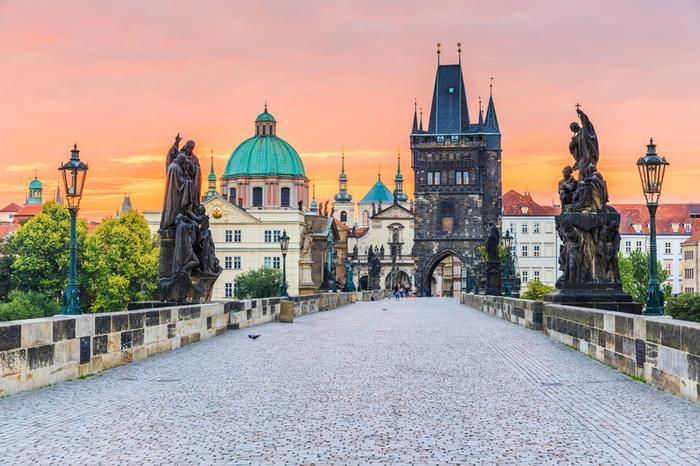
A beautiful bridge that crosses the Vltava river into Prague Old Town.

tags: bridge

Charles Bridge is reserved for pedestrians; it links the two sides of the Vltava, Staré Město (Old Town) and Malá Strana (Lesser Quarter). From the bridge there is a wonderful view of the Vltava valley with its numerous bridges, of Shooters’ Island and Slav Island (Žofín), and of Staré Město and Malá Strana themselves with Prague Castle . Beneath the west piers lies
KampaIsland, which is separated from Malá Strana by the narrow Čertovka branch of the Vltava ( Prague’s Venice ).In summer, the bridge is populated by painters, musicians, and arts and crafts vendors. It rests on 16 piers and is 520m/570yd long and 10m/11yd wide. It was begun in 1357 under Charles IV by
J. Ottland completed in the early 15th century under Wenceslas IV by
Peter Parler. The massive bridge towers on both banks, as well as the bridge itself, once served defensive purposes. Flood disasters have often damaged the fabric of the bridge – two arches had to be replaced in 1890 – yet have never caused it to collapse. In recent times, however, structural damage has been discovered. But although restoration work is planned for the coming years, the bridge will remain accessible. Part of the estimated cost of £7.3 million/€11.25 million/US$15.2 million is to be raised through donations.Charles Bridge makes an enormous impact, largely because of its rich sculptural ornamentation. This statue promenade , which originated for the most part in the Baroque era, is one of Prague’s loveliest architectural achievements and that, combined with the strict Gothic architecture of the bridge, gives it a high degree of artistic appeal. In 1657 a bronze crucifix that had stood here since the 14th century was renovated; between 1706 and 1714, 26 statues were erected by famous artists (Matthias Bernhard BraunBraun, Matthias Bernhard</STICHWORT>,
Johann Brokoff and his sons Michael Josef and Ferdinand Maximilian Brokoff, and other sculptors. In the mid-19th century these were followed by five further statues (by
Josef Max and Emanuel Max); in 1938 the stone group of SS Cyril and Methodius (by Karel Dvořák) was added. The sandstone figures have suffered greatly through the ravages of time and environmental impact; in the meantime almost all have been replaced by copies. The only marble statue is that of St Philip Benizi. The most valuable artistically is the chiselled sandstone figure of St Luitgard, a picture of mercy and grace: Christ leans down from the Cross to St Luitgard and allows her to kiss his wounds. The only statue cast in bronze is St John Nepomuk (in the middle of the bridge). It was cast in Nürnberg in 1683 from models by Matthias Rauchmüller and Johann Brokoff. Between the sixth and seventh piers of the bridge, a relief marks the spot from which St John Nepomuk was cast into the Vltava in 1393 on the orders of Wenceslas IV, because he had opposed the king in an ecclesiastical conflict. Canonized in 1729, he has been regarded since that time as Catholic Europe’s bridge saint . The Crucifixion Group has a Hebrew inscription; in 1696 a Jew was sentenced by the regional tribunal to make this contribution as a punishment for blasphemy.

Charle's Bridge travel guide created by marco polo, last edited by marco polo