
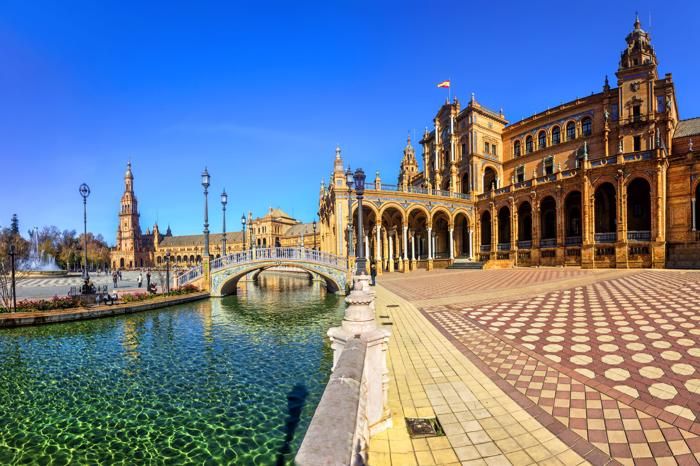
Winding little alleyways, cosy bars, and small shops in Seville's old Jewish district.
“It took Lorenzo Quart almost an hour to find the church ... He realized his tourist map was useless in the maze of silent, narrow streets.” Arturo Pérez-Reverte, The Seville Communion.
Once home to much of Sevilla’s Jewish population, atmospheric Santa Cruz is the most charming of the city’s barrios, a web of narrow pedestrian lanes linking attractive small plazas with orange trees and shady terraces aplenty. Squeezed between the Alcázar, cathedral and a section of the old city walls, it’s very touristy but thankfully not over-prettified, and there’s a fairly standard tour beat that you can easily explore away from. There are excellent accommodation and restaurant options as well as several intriguing antique and handicraft shops; even the souvenir shops are comparatively tasteful. The most atmospheric way to enter the barrio is this: from the Plaza del Triunfo by the cathedral, head through the gate in the Alcázar walls to the south into the pretty square of Patio de Banderas, floored with sand and lined with orange trees. In the opposite corner, duck through a small tunnel and twist and turn your way on to Calle Judería, one of the nooks with most medieval flavour.
A wander through the narrow lanes of Barrio Santa Cruz will reveal much. On one side, the area is bounded by a stretch of the old Almohad city walls, behind which is the public park of the Jardines de Murillo, centred around a monument to Columbus. Nearby, Calle Santa María la Blanca was once one of the city’s entrances; the food markets used to be in this zone and farmers would enter here with carts piled high with meats, cereals, and vegetables. These days, it’s more of a plaza than a street, with several sun-kissed terraces (go for Carmela or Altamira ahead of any place with paellas on display). Try and be here around 1830 to nip into the small church that gives the street its name, when it opens for Mass. The attractive toothed arch of the portal gives little hint of the Baroque fantasy inside: the central vault of the triple-naved church is carved with a riot of floral and vegetal decoration. In the left aisle you’ll see a Murillo, a Last Supper that’s not usually reckoned one of his best works but certainly deserves to be. A young, visionary Christ is surrounded by the wise, bearded old heads of his apostles. It’s all the better for being in situ.
The tapas street par excellence is Calle Mateos Gago, running to the heart of the barrio from Giralda tower. Another centre for eating and drinking is Plaza Alfalfa, tucked away in the north of the barrio, near Plaza del Salvador. The square (not marked as such on many maps; look for the junction of the streets Calle Alfalfa and Calle Pérez Galdós) is busy day and night, first with café action, then no-frills but quality tapas, followed by late-night bars....


