

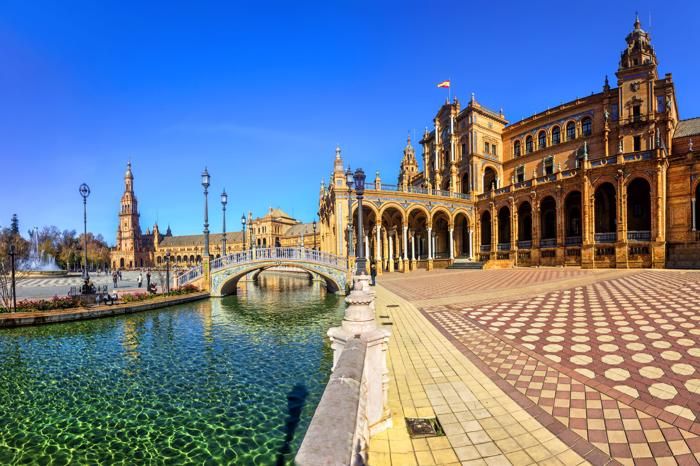
The most beautiful example of Andalusian Mudéjar style: the royal palace in Seville and its gardens.
Even if the delights of tapas and the heat of the day are seducing your hours in Sevilla away from you, don’t head for home without seeing the Alcázar, as you’ll be derided by any friends who have. While you’ll see horseshoe arches, stucco, calligraphy and coffered ceilings throughout, it’s not a Moorish palace. It used to be, but little remains from that period; it owes its Moorish look to the Castillian kings who built it after the Reconquest: Alfonso X and his enlightened son Pedro I.
The informative audio tour (Spanish, French, English, German and Italian) costs €3 and uses quotes from various of the kings responsible for the building’s construction.
As well as being a sumptuous palace, the Alcázar was once a considerable fortress in this impressively fortified city, a fact easily appreciable as you pass through the chunky walls in the dramatic red Puerta del León entrance gate, named for the tiled king of beasts guarding it. You emerge on to a large courtyard dominated by the impressive façade of the main palace of the Castillian kings. Before heading into this, investigate the Patio del Yeso to the left, one of the few remaining Moorish structures, where lobed arches face horseshoe ones across a pool surrounded by myrtle hedges.
Opposite, across the courtyard, are chambers built by Fernando and Isabel to control New World affairs. Magellan planned his trip here, and there’s an important retablo from this period of the Virgen de los Navegantes. In the main panel by Alejo Fernández, the Virgin spreads her protective mantle over Columbus, Carlos V, and a shadowy group of indigenous figures (who might see some trouble coming if they could glimpse the side panel of Santiago, Spain’s patron, who is gleefully decapitating Moors).
From this main courtyard, if you arrive early, it is possible to see some of the upper floor of the palace, still used when Spanish royals are in town. A series of elaborately furnished chambers are visited on the guided tour (€3, you can prebook, which is advisable, on 954-560040), which leaves roughly every 30 minutes.
The palace façade is a fusion of Christian and Moorish styles that just about achieves harmony. Inscriptions about the glory of Allah (Pedro had a deep interest in Islamic culture) adjoin more conventional Latin ones proclaiming royal greatness.
This fusion is repeated throughout this whole section, centred around the stunning Patio de las Doncellas. Throughout the complex are azulejos, topped by friezes of ceramic decoration, while higher up, intricate stucco friezes are surmounted by a range of marvellous inlaid ceilings. Also worth admiring are the imposing doors, some elaborately inlaid. Among the rooms off this courtyard are the Salón de Embajadores, with a beautiful half-orange ceiling and a frieze of Spanish kings; and the chapel, where Carlos V married his first cousin Isabella of Portugal (one of many inbreedings that doomed the Habsburg line).
Adjacent is the Renaissance Palace, heavily altered from the original Gothic by Carlos V and his descendants. In the chapel is an interesting Velázquez portraying a beautiful Virgin placing a chasuble over the shoulders of San Ildefonso. From here stretches the vast and fantastic garden; different sections filled with slurping carp, palm trees and a grotesque gallery built into a section of the old walls. Steps lead down to the picturesque covered pool known as Los Baños de Doña María de Padilla. You finally exit the complex through the vestibule where coaches and horses used to roll in, and you emerge in the Patio de Bandera. There are often small exhibitions in this last section....


Real Alcázar photos
more Real Alcázar photos